“Whatever she has been through in the past, and even though she may still have her episodes of fear and anxiety in certain situations, she has become a fierce little superhero in the context of our evening play.”
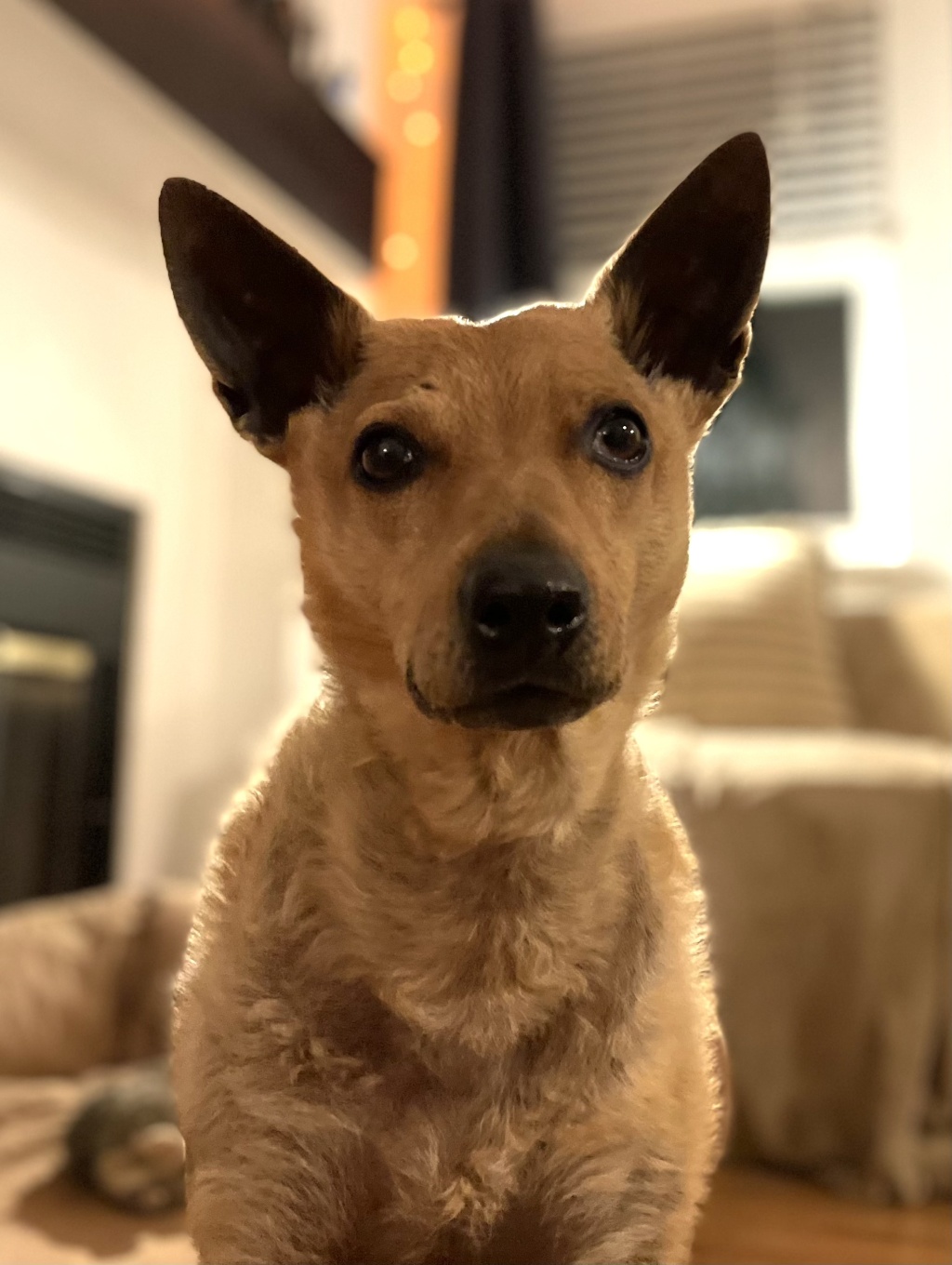
I adopted Beep in January of 2020. She’d been accepted as a transfer to the Best Friends sanctuary in Kanab, UT from a rescue in California. She’d been dumped after her guardian was arrested and their RV was impounded. She was very fearful. It took the local shelter authorities a couple of weeks to catch her. A local rescue pulled her and transferred her to Best Friends. Beep weighs about 35 pounds and has naturally occurring baldness over a lot of her body; this is presumably because she is part Xoloitzcuintle, or Mexican Hairless dog. She’s so beautiful and innocent and sweet that it makes my heart ache.
My wonderful big brindle Powie had died a few months before – I still miss him so – and I wanted some dog company for my other dog, Henny. Henny could be very picky with other dogs, so I needed to find someone with whom the chemistry was right from the start. I asked my friend Megan to find the right match for us. My faith in Megan was justified. The first dog she suggested was Beep, and Henny liked her from day one.
For the first few days after I adopted Beep, she sat on the couch and trembled. She certainly was not the most fearful dog I’ve worked with; in the brief time she was at Best Friends, she got to be comfortable enough with one or two of her caregivers that she would jump up on them briefly when she was excited. She did not want them to touch her, though. And she was leash trained: if approached her slowly I could put a harness on her, and she would go for walks with me and Henny. But still, most of the time she was clearly afraid.
Flash forward to today. While Beep is still shy around strangers and doesn’t want them to touch her, she will readily approach them for treats and there are a couple of people with whom she’s passed a consent test. With me, though, she is beyond comfortable: enough so that she wrestles with me. It is so gratifying to see her comfortable enough that she will leap on me, play bite and wrestle at close quarters for minutes on end. She’s a great case study and this is my story of how we got to this happy point.
How we got to “Attack Town”
A few years ago, Henny decided that one walk a day was enough for him, and he stopped wanting to go on our evening walks. So I used the time instead to play games indoors with him and Beep. Every evening we would play on the floor. I would play tug and wrestle with Henny. While she seemed interested and a little excited by our play, Beep started out watching from the sidelines. She’d circle us for the entire play session, but she did not want to participate.
We started out making sure the environment felt safe for her. I think the two most important elements for a safe space for a dog are familiarity and predictability. So, I made sure that our play area was as familiar and predictable as possible. We played in our living room on the floor.
The next and possibly most important aspect of our plan was to let Beep call the shots. With fearful dogs, it is always safest and best to let them take everything at their own speed, and not to force them into any contact or situations where they feel uncomfortable. I always let her make the choice.
It helped tremendously that Beep was well-socialized to other dogs, and they could help her to feel more comfortable. Having Beep watch me and Henny play was a great way for her to learn, by watching him, that the play could be safe. She was much more likely to be comfortable this way. When one dog becomes more likely to engage in a behavior simply because another dog is doing it, it’s called social facilitation. This can be one of the most powerful tools in helping dogs who are well-socialized to other dogs, but not to humans or other stimuli. This is, incidentally, very common in breeding dogs rescued from puppy mills.
When helping a fearful dog, it’s also critical to figure out what the dog likes and to work that into the plan. Luckily for me, Beep has always been pretty easily motivated by food. All healthy dogs are food motivated; any living thing, by definition, has to be interested in food to stay alive. When someone says their dog is “not food motivated,” it means that in certain situations the dog may be too distracted, or focused on some other reinforcer, like play, that might be more compelling at the moment. The food may also not be high value enough for the dog to show interest, or of course the dog may be too stressed to take food in the moment.
So, we worked lots of treats into our evening games. The games evolved into a “find it” game for Henny, where I would hide a toy, and when he found it both he and Beep would get treats. (This has also resulted in Beep becoming quite a cheerleader for Henny; she gets very excited when he finds the toy and brings it to me.) Later, when Beep became more comfortable with me touching her, I would interrupt petting her to give a treat. This helped her form a strong association: being petted during play predicts food.
The petting itself was also a valuable tool in helping Beep come to enjoy the play time, but it had to be done on her terms. When she got comfortable enough to regularly pass consent tests with me, I started giving her short massages in ways that felt really good to her. I discovered that she likes gentle scritches around her neck and ears. I would do this with her briefly outside of our evening games, so that she started to really enjoy the contact, and would be more likely to approach me for it during play time.
Beep has never played with toys. I’ve tried to get her to play with them, but she just doesn’t seem to see any value in it. So, while Henny has plenty of fun with toys in our play sessions, I don’t use them for Beep. Every dog is different, and there’s nothing wrong with Beep just because she doesn’t see any value in toys. (Once in a while I still try to entice her with a toy, just to see if she’ll show any interest, but she continues to show no interest.)
As Beep started to get comfortable enough in our play sessions that she would approach me and pass consent tests, I continued to be very careful always to give her the choice to move away. I was always very conscious of not restraining her, even slightly, during our play.
While petting Beep during our play, I always adhered to a valuable rule in helping dogs enjoy any experience: always leave them wanting more. I would always stop petting her well before both she and I wanted it to stop. This is the underlying concept of a consent test, and so in a certain way the play became a series of many small consent tests. I would deliberately take my hands off her, just when she seemed to be enjoying the contact most. It was when I would do this that she would often be the most insistent about having me continue. By stopping when she was enjoying it most, it made her want me to do it more than ever.
Another way to “leave them wanting more” on a more macro scale is to keep overall play sessions short enough that we’d stop before either dog got bored. This way, they’ll always be excited for the next time we play our games.
Last but not least, my body language figured greatly in helping her become an all-start wrestler. Here are a few ways this worked:
- Self-handicapping: in healthy play between dogs, you’ll often see deliberate efforts by the larger/stronger dog to use far less physical force than they are capable, and to put themselves in compromising positions: for example, lying on their back and letting the smaller dog climb on them. To mimic this during play, I often get low and lie on my back, and I don’t resist when Beep jumps on me.
- Vocalizations: I started off always speaking to her in soft, reassuring tones. When she started to interact, I began sometimes vocalizing in higher-pitched or growly tones that got her excited, while always being careful to avoid startling her.
- Backing away: dogs often instinctively want to chase a retreating object. Beep was much more likely to charge and jump on me if I was running/backing away from her in some situations, and this was even more effective when I added that excitement-inciting vocalization. Backing away like this and creating excitement to make a dog want to chase you, can be a very important part of a good recall (come-when-called) training plan.
All of this added up to Beep becoming what I call “flying teeth and toenails.” She hurls herself at me, paws at me, and bites at my face; so much that I named our nightly games “Attack Town.” If then I lay still and give her gentle massages, she lies on top of me and chews on my nose. I often interrupt these little make out sessions for a “kiss treat,” where I hold a treat in my mouth and she takes it out, often getting as much of my lip as she does the treat. (This is usually all happening while Henny is off on the current search phase of his find-the-toy game.)
So now, I often end up with some scrapes and cuts after our nightly games, mostly on the bridge of my nose, but often elsewhere on my body, too. I know this level of physicality isn’t for everyone, but I love it, because I know that it means Beep has lost herself in careless abandon and is having the time of her life. Whatever she has been through in the past, and even though she may still have her episodes of fear and anxiety in certain situations, she has become a fierce little superhero in the context of our evening play.
These are the days!
 PowerPuppy Behavior and Training
Leave a comment